Subscribe to the Prophet’s ‘Love-Cast’
True identity comes from subscribing to the Holy Prophet ﷺ and his message of love, mercy, and compassion.

Yesterday, I was walking through the Sharjah Book Fair. Very coincidentally, I got to meet a senior friend. So when I asked him what I should talk about at today’s event, he told me, “Don’t say too much when you go there. Talk about your kids.”
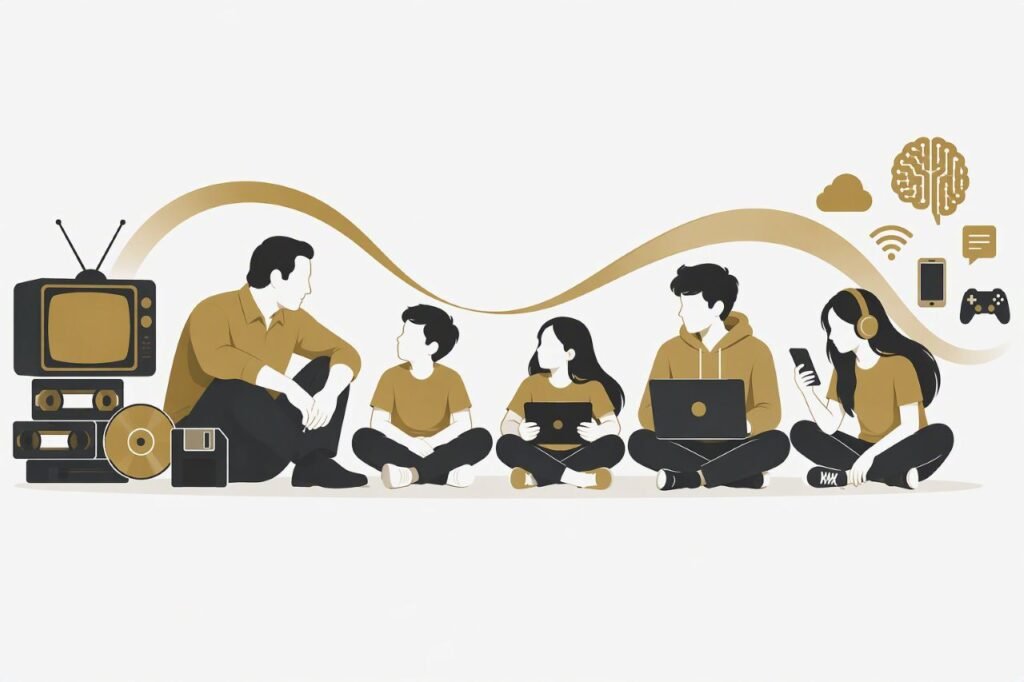
So I am a Gen X father of two Gen Z kids. I have heard a lot from my father, many stories from him about coming to the UAE on a launch boat, struggling here, and so on, and I have been amazed. I too started from very humble origins here, then studied in a regular Indian school, followed by a local college, and now I am working.
My kids, one is doing his AS levels in Grade 11, and the other is in university. Between us at home, not just occasionally, but almost every day, good conversations happen, those spontaneous generational conversations. So we talk about eating food, watching TV, mobile use, Wi-Fi timings, and so on. That means we fight. When I say “talk,” it actually means we fight. So my wife and I are always researching how to convince them, just like you all do.
I write. In fact, I am a published author. So language, for me, is a very sacred thing. I am very particular about language. Literally, words mean a lot to me. So I don’t make any compromises on that, in quality or in expression.
So a part of how my kids question me now is by asking why I put a full stop when sending a message. That is, “How are you?” comes with a question mark. So the kid asks, “Why do you need a question mark like this? You could just write it without a question mark. Why do you have to be so serious?” To me, a question mark is a big, important thing because, without it, that sentence is wrong, incomplete; it is unholy.
So even over things like that, conflicts, debates, fights, and arguments happen between us.
Let me tell you something short and sweet: No one chooses the generation they are born into. The era we are born into, or our clan, in earlier times, family, we don’t choose that. Me being Gen X, I didn’t ask my Creator to birth me in this era.
We usually say we don’t choose our parents. And we don’t choose our boss either. When we join a job, we can’t choose our boss. We can’t say, “I don’t like this boss; please change him.” The boss chooses us.
So our generation was decided, determined by the Creator. Every human being is born into their respective era. So God knows that you will perform your best when you are born into this particular generation. That is God’s determination, God’s knowledge, God’s decision. In short, it is fate. The word “fate” that we casually use is a figurative way of saying, “This is God’s will.”. So we cannot evaluate or question that fate.
That’s why, in the generation I was born into, there were VHS cassettes, analog TV, and antennas. In my childhood, there was a channel on which if a movie or something came on and wasn’t clear, we would go up on the roof of the house, turn the antenna, and fix it. We were a fun-loving generation.
To my kids, I have to explain what an antenna is. To my kids, I have to explain what a CD-ROM is, or a floppy disk.
So as each generation advances, the things of the previous generation gradually get pushed into a museum. Now, if our kids are to know what a CD-ROM, a floppy disk, or similar equipment is, we have to take them to a tech museum. That is neither a shortcoming of ours nor an advancement of our kids.
So if we take three generations, for example, my grandfather, my father, and me, think about a scene where my father is sitting near my grandfather. If my grandfather were stating a math problem, my father would write it down on paper. The former would have said, “Why do you need to write it on paper? Do mental math. Mental math is lacking.”
If my father tells me a math problem and I type it into a calculator or another device, my father will ask, “Why are you typing it? Why use a calculator? Wouldn’t writing it on paper be enough?”
If I tell a math problem to my son and he quickly asks ChatGPT or Gemini, I will say the exact same thing as my grandfather and my father said. I will say to my son, “Why are you using the chatbot? Why can’t you just work it out yourself?”
So this is a transfer of knowledge. Nobody chooses it on their own merit.
All of us are born into our respective generations, our respective eras. We cannot mix that up. I cannot ask my son, “Why are you doing it this particular way?” Just like my father cannot ask me, “Why do you do it like this?”
When I first got my driving license and drove a car, my father used to say, “Why are you driving like this?” I ask the exact same question to my son now: “Why are you driving at that speed?”
So if our fathers lived life at 1x speed, I am going at 1.5x. My kids, at that same ratio, are at 2x. They drive, study, watch movies, everything is at 2x.
But the next generation after them might be watching or moving through life at maybe 2.5x. So merely being Gen Z is not in one’s merit. It’s not a choice you made out of your own wisdom.
For example, if we tell a Gen Z person to look at something on Facebook, or to write or post something there, Gen Z kids will say, “Hey, that’s something grandfathers and grandmothers use.” They’ll say it’s cringe. Right?
If you say YouTube, they’ll say, “Hey, YouTube is for older people. We use Instagram,” or whatever.
Therefore, this transfer of platform preferences applies to every generation. For example, if I am from the Facebook generation, my Gen Z kids, or maybe my younger brothers, will be using Instagram. The Instagram people will be considered old by those who are using Snapchat. Right?
So from YouTube to Facebook, Twitter to Instagram, to Snapchat. And the next generation might say the same thing about Snapchat and move to something else.
Generations have decisions that are their own. What we need to understand is that every generation has its own lifestyle, its own unique thinking pattern. They don’t have an obligation to convince the previous generation. Similarly, the previous generation doesn’t need to ask the next generation why they do what they do. Every human being is born into their own era. They are born into the right generation.
But many of the things we see today in kids make our heads itch and drive us crazy. If you say something from one room, by the time that kid goes to the next room, they forget what was said. They cannot remember; they cannot recall what their father or mother told them.
However, we must not learn life from technology. Kids should understand that. That is important. Parents across the world are thinking and worrying about how to connect with Gen Z. Especially for us living here, the biggest challenge for parents is not paying rent or credit card bills. How to communicate with their Gen Z kids is a major issue troubling parents everywhere.
This issue does not end with a class or a campaign. Social organizations should take this topic up with even greater seriousness, bringing this discussion and these platforms into schools and colleges on a long-term basis. You should attract more Gen Z members into your task force.
In our country, India, very senior and seasoned politicians have even changed their social media language to appeal to GenZ. They have changed their dress code. Because we can blame Gen Z, we can say anything. But whom are we going to hand over tomorrow to? We have to say bye-bye from here anyway. So who will take charge of our future, the social platforms and ecosystems that we worked hard to build over such a long time? Only Gen Z can take charge. We have to leave this world one day anyway.
Since I am in the field of writing, whenever I see a word, I always have a special interest in finding meaning in it. We named our, here, our great CH. Its abbreviation stands for C for Compassion and H for Heart.
So let’s connect our ideas, thoughts, and all our actions with compassion and with the language of the heart. Maybe that’s why the Creator intended CH’s name to be that way. So let’s pray that we get the opportunity to communicate with Gen Z with compassion, in the language of the heart.
***