
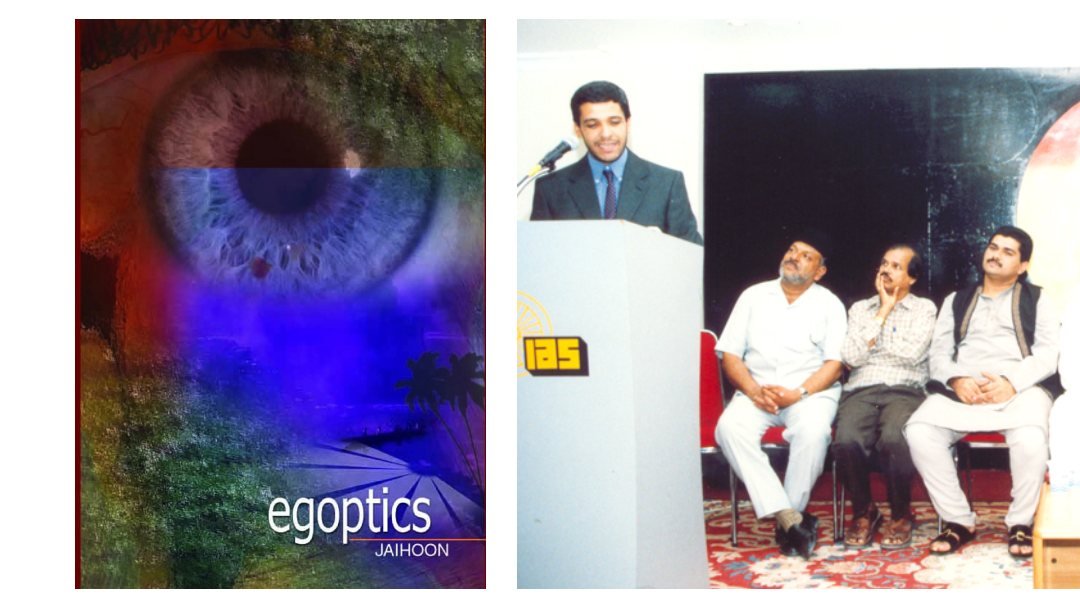
“This is an attractive cover here on the book!
I normally send my reviews by mail, so the author has never seen me. Anyway, I will give it a try. Honorable guests, proud parents…
It is always difficult to review poetry in general, and creative writing, let alone a collection by a young and promising writer. It is further difficult to talk about a writer who brings together different cultures, languages, and different socio-economic locales. Further still, it is more difficult to talk about writing that relies heavily on inter-layering and inter-borrowing of languages, realizations of thoughts, etc.
All these make it difficult—see how many times I have repeated the word DIFFICULT—to read or interpret Egoptics. The name itself is difficult, and also the ‘dotcom.’ Those who visited, make sure you visit again.
This is surely an excellent collection of poems and essays, and it is surely excellent as a first attempt. Bringing together all these under one note of culture, language, and social adjustments—of, as the gentleman here referred to, a young boy from India grown up here who went to an Indian school in Sharjah—bringing up all these together, a run through these poems and essays in this really thought-provoking collection…
If these problems are not enough, then consider the problems inherent in the writing by Jaihoon. His writing reflects translation of words, of cultures, of language, of attitudes, of habits, and of his deeply-rooted religious beliefs. These are all emotions and signs—some of them are sacred, some of them are not so—inter-lines and inter-structures that convey his own individual spirit. It is a spirit, a presence, constructed in a language and transformed through a language unique to Jaihoon. Simple, easy words we encounter on an everyday basis—soul, jannah, internet, e-something, female, crazy, tasbih—these are simple words; you hear them and use them everyday. They become almost meaningless. But when you read them as put together and injected with certain meanings in this little collection of poems and essays, then they show some sensibility which runs across…
But a number of questions arise. What is he trying to cover? What is he trying to repress through these verses and these assumptions—either embedded or intended—through the metaphors he uses? Are they good or bad? Where is one reading the conventional meaning, and where is one reading the meaning intended by the author? What is left open before you to read for the price you pay? Questions, questions…
What can we expect from a volume called Egoptics? What can we expect from a marketing mind at the edge of e-technology? Simply: complexity, yet simplicity at its best.
Perhaps Jaihoon’s symbols transverse the identity of the English language itself. It is fitting that the volume opens with the quote from His Highness Dr. Sheikh Sultan bin Muhammad Al Qasimi, Supreme Council Member and Ruler of Sharjah. Sharjah, to which Jaihoon devoted a whole poem, shows for me a maturity—a unique maturity—at the level of command of the manipulation of words and the deformation of the meanings of words.
Back to my preface. It is very difficult to predict what may follow Egoptics. I wish him success and am sure of what I have seen so far while reading this: success. I am sure we’ll see more ‘Ego’s to come from Jaihoon.
I hope his success tonight is not going to lead to creative stagnation. And I am sure, as the little quotation from His Highness on the first pages of the book suggests, that this is surely a candle lit.”
2002. Summarized transcript of speech by Prof Said Faiq at the release function of Egoptics, first book by Jaihoon.
Dr. Said Faiq, Professor, PhD, University of Salford, United Kingdom
With some 30 years in academia in Africa, the Middle East and Great Britain, professor Faiq is an established teacher and researcher in the interdisciplinary field of inter/cultural studies. He has taught English, linguistics, translation and interpreting, intercultural studies, media and communication. His research sits at the interface of intercultural communication, media and representation as discourse (managing intercultural encounters in/of human interaction and behavior). He has published widely on these issues. He has assumed a number of academic administrative positions, including head/chair of departments, and director /coordinator of graduate and undergraduate programs. [https://www.aus.edu/faculty/said-faiq]