Betrayal of the Intellect: Why Khalil Pelted Satan
Love has only one adamant clause: loyalty to the ultimate Beloved, even if it requires the betrayal of human intellect,
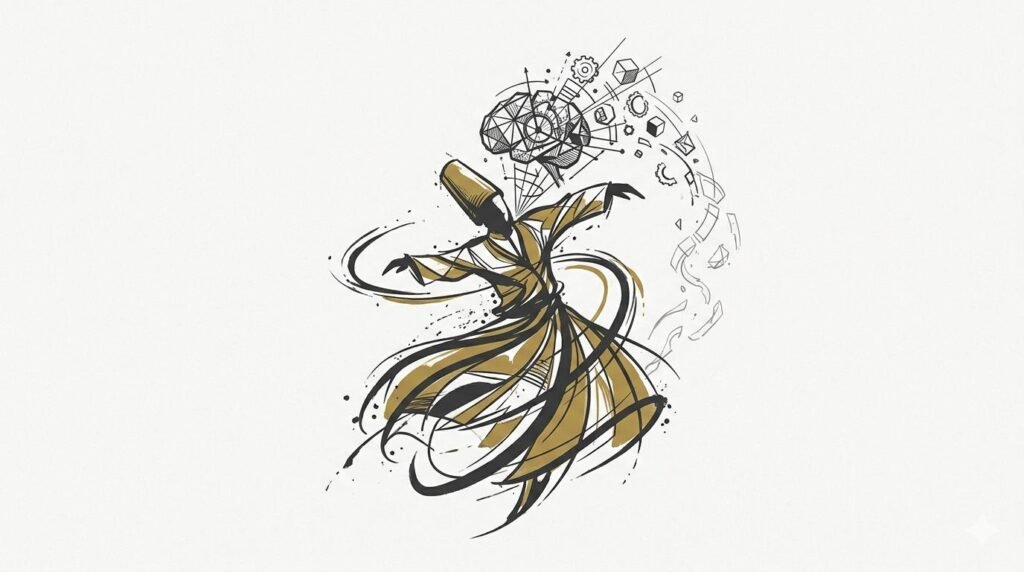
I asked the ‘Sage of Seville’,
In a dream as true as real:
“I believe and behave
As much as I can behold.
I submit my health, wealth,
My life and death too.
Anything more to concede
For my Faith to be complete?”
Said the ‘Shaykh the Great,’
The scribe of ‘Futuhat’:
“Life and death
Even the beasts sacrifice.
Faith remains incomplete
Until your logic forfeit.”
Jun 01, 2026 | Dhu al-Hijjah 15, 1447
The “Sage of Seville” and “Shaykh the Great” (Arabic: Al-Shaykh al-Akbar) refers to Ibn ‘Arabi (1165–1240 CE), one of the most influential Sufi mystics, philosophers, and theologians in history. He was born in Murcia, Muslim Spain (Al-Andalus), but grew up and studied in Seville. The poem explicitly mentions him as the scribe of Futuhat, which refers to his magnum opus, Al-Futuhat al-Makkiyya (The Meccan Illuminations). This massive work maps out spiritual cosmology, metaphysics, and the inner meanings of Islamic rituals.
Context: During the Islamic Golden Age, a massive intellectual debate raged between rationalist philosophers (like Ibn Rushd/Averroes, who also lived in Seville at the same time as a young Ibn ‘Arabi) and mystics. The Rationalists argued that human reason was the ultimate tool to understand God and the universe. Ibn ‘Arabi and the Sufis countered that while reason is useful for worldly matters and basic theology, it acts as a cage for higher spiritual realities. Because God is infinite, He cannot be ‘caged’ within the box of human logic.
“Until your logic forfeit” The poem concludes that faith is incomplete until logic is forfeited, it directly echoes Ibn ‘Arabi’s philosophy of Kashf (spiritual intuition or unveiling). In Futuhat, Ibn ‘Arabi argues that the rational mind is constantly trying to limit things to cause-and-effect. True spiritual realization requires a step beyond rationality into suprarationality by recognizing the absolute limits of the human brain.
“Even the beasts sacrifice“: Physical existence and basic survival instincts are shared across the animal kingdom. What makes the human spiritual journey unique, in the Akbarian view, is the conscious decision to bow the arrogant intellect before divine mystery.

Mujeeb Jaihoon explores themes of universal love,
deeply embedded in a disruptive spiritual worldview.
Love has only one adamant clause: loyalty to the ultimate Beloved, even if it requires the betrayal of human intellect,
Masking their soul-shine behind ordinary forms, God’s lovers wait for the dust to settle to rejoice alone—writes Mujeeb Jaihoon
By weighing the count of forgetting against remembering, this poem proves that math always fails once the self dissolves in
Our everyday choices are emotional, not rational. We demand proof for God but never for the morning coffee.